History you can enter
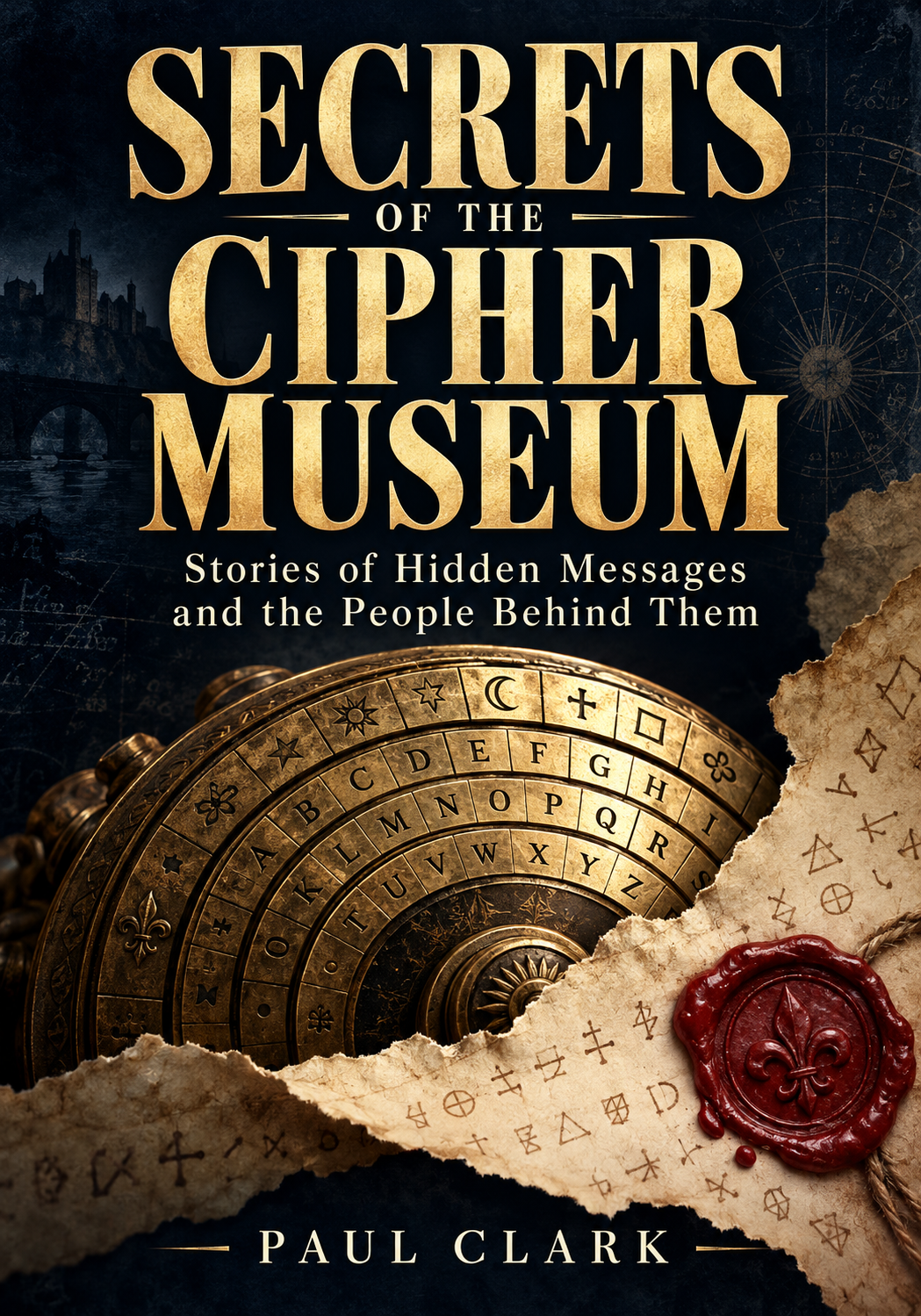
Secrets of the
Cipher Museum
Stories of Hidden Messages
and the People Behind Them
Discover how people learned to read other people’s secrets—and what happened when they did. Then enter Cipher Museum and try the ideas yourself.
Book preview · Publication details to follow
People. Power. The message in between.
The words were secret.
The consequences were not.
A captive queen’s private post belongs to her enemy. An intercepted telegram becomes a diplomatic problem. A recovered message exposes a network—and leaves an investigator with a harder question: what will count as evidence?
Across twenty historical investigations, Secrets of the Cipher Museum follows the people who sent, intercepted and recovered hidden messages. From Mary Stuart to the public struggle over encryption, the story asks who gets to read, who gets to act, and what happens next.
No advanced mathematics is needed. Eight original diagrams help where the machinery matters. Notes keep the evidence—and its limits—within reach. Chapter links and QR codes lead to free museum exhibits where you can try simplified methods and explore documented recoveries.
An envelope is waiting for you
The Curator’s Sealed Letter
Four optional slips run through the book. Solve them to open a fictional document investigation in the museum, or start the case directly online. The challenge is not just finding readable words. It is deciding what those words justify.
Open the reader’s mystery →Try it free, with hints. No purchase or account required.
From chapter 1 · Opening excerpt
The queen’s other reader
The beer arrived at Chartley Hall with something concealed in the barrel's bung.
For Mary, Queen of Scots, the small packet restored a connection to the world outside her imprisonment. Letters could come in. Replies could go out. A household delivery, ordinary enough to pass through a guarded residence, had become a private postal service. The people who carried it appeared to have accomplished what years of royal negotiation had failed to do: they had made a breach in the walls around her.
Mary had been in England since 1568. She had arrived seeking help after losing her Scottish throne and a battle to recover it. Elizabeth I had supplied a succession of residences and keepers. Eighteen years later, the distinction between a royal guest under protection and a prisoner was difficult to sustain. Mary could not leave. Her servants, movements and correspondence depended on decisions made by another queen's government.
There was a reason Elizabeth found her impossible to release and difficult to kill. Mary had been Queen of Scotland since infancy and, briefly, Queen of France. She was also a descendant of Henry VII, with a claim to the English succession. To Catholics who rejected the marriage of Henry VIII and Anne Boleyn, Elizabeth's legitimacy was itself in doubt. Mary offered a royal alternative to England's Protestant settlement. Keeping her captive preserved the danger. Sending her abroad might give that danger an army.
Mary's own story had supplied her enemies with plenty to use against her. Her second husband, Lord Darnley, had been murdered in 1567. Her subsequent marriage to the Earl of Bothwell, widely suspected of involvement in the killing, had helped turn Scottish opposition into rebellion. She had been forced to abdicate in favour of her infant son, James. After escaping confinement in Scotland, she had raised troops, lost at Langside and crossed the border.
What had looked like a temporary refuge became the remainder of her life.
By 1585, the supervision had tightened. Sir Amias Paulet, her new keeper, treated the restriction of her correspondence as a serious duty. Letters were how an imprisoned sovereign continued to exist politically. Through them she could seek money, cultivate allies, give instructions, dispute reports and remind foreign courts that she still had a claim. Cut off her letters and she became easier to reduce to the management of a household.
The route through the beer barrels therefore offered more than consolation. It restored a means of action.
It also belonged to Sir Francis Walsingham.
The private route had another reader.
Excerpt © 2026 Paul Clark. Historical source notes for this chapter draw on Simon Singh’s The Code Book, Alan Bryson’s British Library essay “The Gallows Letter”, and the documentary history discussed in the manuscript’s chapter notes. This is an opening excerpt, not the complete chapter.
Explore the Babington exhibit →For libraries, classrooms and curious friends
Read. Compare. Discuss.
A simple 30–45 minute session: read the opening excerpt together, try the first two slips, then use the online hints to complete the letter. Decode the dispatch, compare the four initial documents, and choose a fifth source before discussing the accusation.
- Who controls a communication route—and who merely believes they do?
- What changes when the same message survives in two versions?
- Which statement in the fictional case is an observation, and which is an inference?
- What one additional source would most improve your confidence?
The online activity is free to use without accounts. Participants can work individually or in pairs. No previous codebreaking experience is required.
Start the group activity →